Banks, Iain. The Wasp Factory. London: Abacus, 2009. Print.
Colapinto, John. “Gender Gap: What were the real reasons behind David Reimer’s suicide?” Slate Magazine. 3 June 2004. Web. 5 May 2011 <http://www.slate.com/id/2101678>.
Gender Equality Symbol. Digital image. ReligiousTolerance.org by the Ontario Consultants on Religious Tolerance. Web. 5 May 2011. <http://www.religioustolerance.org/tgsymb.gif>.
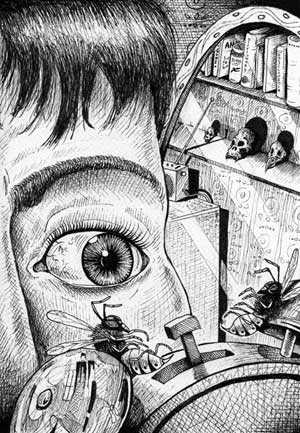
Ivory, Tom. Wasp Factory. Illustration. Web. 5 May 2011. <http://www.artshole.co.uk/arts/artists/Tom%20Ivory/wasp-factory.jpg>.
Sosin, Kate. “Ze likes Hir Pronouns Just Fine: A Lesson in Using Gender Neutral Pronouns.” Chicago Now. 27 April 2010. Web. 5 May 2011 <http://www.chicagonow.com/blogs/new-gender/2010/04/ze-likes-hir-pronouns-just-fine-a-lesson-in-using-gender-neutral-pronouns-101.html>.
“The Boy who was Turned into a Girl.” BBC. March 2004. Web. 5 May 2011 <http://www.bbc.co.uk/science/horizon/2000/boyturnedgirl.shtml>.
Thirlwell, J.G. "Warped Carousel." The Venture Brothers – The Music of J.G. Thirlwell. Williams Street, 2009. Youtube. 27 Mar. 2009. Web. 5 May 2011.
In the story, Frank was born a healthy female and is given hormone treatments by hir father to make hir male; gender identity and gender portrayal is an emphasized theme (as I mentioned in the previous post), and Frank’s discovery of this secret provides the book’s climax. I was actually able to predict the plot’s major twist, because it reminded me so much of a story I’d heard about in the news several years ago. David Reimer was born as a male, but was raised as a female after his penis was unintentionally destroyed during a circumcision; David’s parents talked about with psychologist John Money about his idea that gender identity is learned behavior, and with his encouragement opted to have David (given the birth name Bruce) undergo sexual reassignment surgery and changed her name to Brenda. Eventually, it was revealed to Brenda that she had been born a male, which came as a relief to her because she never truly identified as female despite never knowing anything about being born a male.BBC has a more in-depth synopsis of the case here, and it’s definitely worth a read; according to the article, this case provided “the ultimate test [to see if] nurture could override nature” (BBC). What the article doesn’t say, however, is that David eventually committed suicide after years and years of severe depression (Slate).
Gender equality symbol from ReligiousTolerance.org
One of the major ideas in the novel is the idea that people are extremely biased in their thoughts because these thoughts are heavily influenced by our upbringing and surroundings; Frank is an example of how a very small view of the world can be fatal. Ze constantly justifies hir actions by bringing hir own moral framework into things, but in the end everything ze used to justify hir actions and everything ze believed is revealed as a lie. This theme also extends to how influential people in our life can have an unhealthy power over our thoughts: Frank’s father lied about who Frank really is and this is what rocks Frank’s foundation to the very core of hir being. Frank even mentions that ze knows hir father lies about most things, so it is obvious that this was a very intentional inclusion in the book’s overall theme. The book also criticizes how society views violence, gender, and social ideals in this manner; we base our morality on our feelings and we glorify things without any real basis. Misogyny is revealed as ridiculous, because even though Frank professes how weak women are, ze was born a woman and is the complete opposite of how ze stereotypes women. The book shows that children aren’t as innocent as we would like to believe, because they are just as vengeful as the older crowd; violence is still portrayed in a negative light, however, as the book does have an anti-military feel to it. Frank’s fanatic adherence to hir rituals are reminiscent of the rituals that religious people often adhere, because these rituals are based on superstitions and are ultimately performed for the sake of tradition. Ultimately, the book serves to criticize the way humans justify things and how we strive for ridiculous ideals, and Frank represents all of because ze clings to ideals that have no real basis other than hir own biases and selfish, primal desires.
The story takes place in Scotland and while the story has a timeless feel to it, I’m inclined to say that it takes place in the present. Frank lives on an island where ze is completely isolated from most of society, and the scenery highlights this feel of dreary, self-imposed isolation. The weather seems bleak and dark, which creates the perfect atmosphere for a violent horror story. Frank also believes in a sort of supernatural power that shows itself in physical ways (such as with the Sacrifice Poles, a set of poles Frank has set up to protect the island, and the Wasp Factory, a sort of labyrinth where ill-fated wasps go to choose their demise), giving the book a very eerie tone that is a classic element of Gothic horror.
The Wasp Factory is a sort of coming-of-age story that revolves around Frank Cauldhame, a seemingly disillusioned sixteen-year-old, as ze discovers that everything that ze once believed is a lie. The book starts off with Frank describing the island that ze lives on in Scotland, where ze has isolated hirself from most of the surrounding community. The plot is deceptively simple in the sense that the main action of the book revolves around Frank waiting for hir brother, Eric, to return home: Eric has escaped from an insane asylum—having been put there for losing his mind and eventually causing all sorts of chaos, such as lighting fire to dogs and eating them—and the entire story takes place in the span of around two weeks. During this time, Frank describes hir way of living, hir way of thinking, and hir past.
Frank committed hir first murder at age six and then ze killed two more family members a few years later; during the book’s present time, Frank describes this as “just a stage [ze] was going through” at the time and that ze doesn’t intend to kill anybody else. The actual reasons for the murders are varied, but each instance points back to the abstract ideas of innocence, justice, and reason that we as humans tend to value. Frank lives hir life following a set of ritualized behaviors and looking for “signs” for what to do next; as ze waits, Frank keeps busy by building weapons and killing animals so that ze can attach their heads to the “Sacrifice Poles” ze has created to protect hir island.
***Spoiler alert***
Throughout the novel, Frank expresses hir hatred of women: ze sees them as being weak and stupid by nature. In the end, however, it is revealed that Frank was actually born female and that hir father decided to perform an experiment to see if Frank could successfully be raised male: Frank was told that zir enlarged clitoris (caused by the hormones the father has been giving hir for years) was actually a dismembered penis, the result of being castrated during a brutal dog attack. The book ends with Frank’s realization that hir whole world has just been shattered and that hir entire reality has been undermined. Now, ze is left to question everything ze once knew about hirself and the world around hir.
I chose to cover The Wasp Factory by Iain Banks because it was a gift from a very close friend of mine. I had yet to begin reading the book when I made this choice, but I was confident that I would enjoy the story; having now fully read the story, I know that I made a good choice. I actually read the book from start to finish in less than a day, because I could barely stand to put it down after I'd started it. The book poses philosophical questions by giving the reader plenty of statements, attitudes, and beliefs to analyze without ever explicitly telling the reader to think about anything; the social commentary is seamlessly embedded in the plot, which makes the novel more than just an extremely fascinating story.
The novel is written in the first person, and Banks uses a very dark sense of humor to describe some of the protagonist's more horrifying actions. I couldn't help but laugh out loud at some of the descriptions (a very rare reaction for me), and immediately afterward I would cringe with guilt because the situations really shouldn't be laughed at; Banks, however, succeeds at making these ghastly scenes somehow comedic, and this tone makes the reader's need for analysis even greater, to search for some meaning to everything, some cause. In the end, this need to justify things is criticized at the end, as the protagonist's sense of self is utterly destroyed.
The above music video, "Warped Carousel" by J.G Thirlwell seems to be a fitting aural accompaniment to The Wasp Factory. If you don't have time to read the book, this song gives a fairly good sense of what reading the story felt like for me. However, I urge you to give this book a read at some point; it's delightfully dark, captivating, and a wonderful introduction into the world of Gothic horror!
I would also like to note that in this blog I will be using the gender neutral pronouns "ze" and "hir" in place of "s/he" or "his or her," respectively, as well as possibly using the occasional singular "they" when referring to Frank, out of respect for the transgender/transsexual community. Kate Sosin of Chicago Now wrote an excellent article explaining why some people are in favor of using gender neutral pronouns, and I strongly encourage all of my readers to read it. As this book deals with gender identity and stereotypes, I feel that this is an appropriate way to address the topic in my writing.